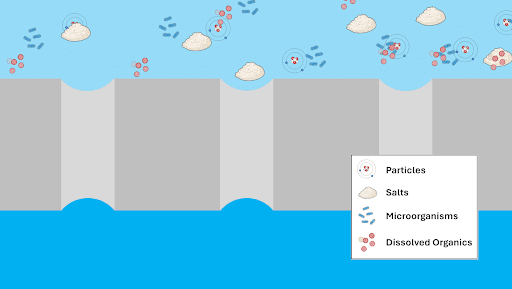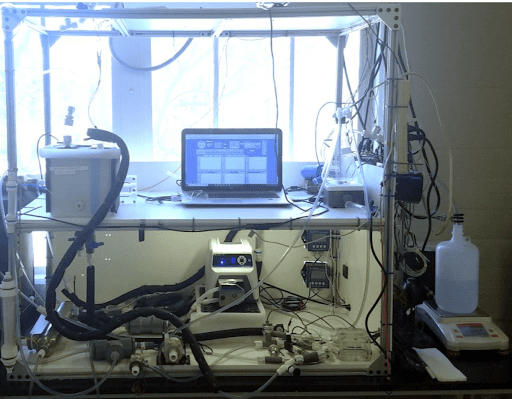
By Quyen Le, Chemical Engineering Major, Mentor Dr. Allyson McGaughey. Water scarcity remains a significant challenge in various parts of the world. To address the issue of limited water resources, water providers are exploring ways to treat and reuse water from industrial processes and municipal wastewater. Membrane distillation (MD) is a water purification technique that utilizes a membrane to separate water from contaminants. This process uses the differences in vapor pressure across the membrane, allowing water vapor to pass through while rejecting dissolved solids and other impurities. MD can treat wastewater with high salt concentrations and complex contaminants, enabling treated water to be put back into use. MD has been demonstrated in Dr. McGaughey’s research to be an efficient method for treating high-concentration waste streams and achieving complete rejection of nonvolatile solutes if membrane properties are carefully controlled. Additionally, this method is also efficient because of its relatively low capital/operating costs and ability to utilize low-grade “waste” heat and solar thermal energy, making it a promising solution for sustainable water management. For this communication project, I am creating an animated video and infographic about the membrane distillation process for those interested in this topic within the research community. This animation can be used to communicate MD and its application in wastewater treatment on research websites and during the UROC. This project aims to simplify and communicate complex scientific concepts related to MD to a broad academic and general audience, encouraging support for sustainable water management practices and inspiring future research and innovation in the field.