
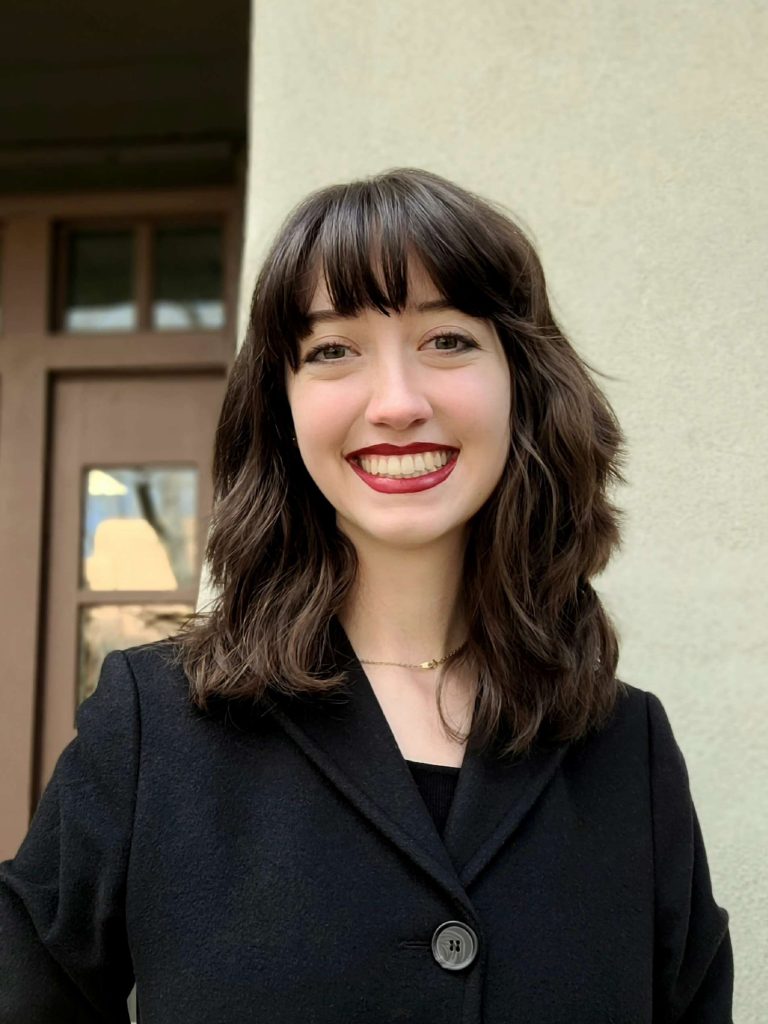
By Savannah Phelps, Honoarble Mention Research Story UROC 2025
Since high school, I’ve always felt a strong pull towards the arts and humanities. I felt deep personal fulfillment in discussing books and going to art museums, but I was consistently told that such things were impractical and invaluable in today’s world. Nevertheless, it seemed to me that even if all it was was fun, it couldn’t hurt. It wasn’t until I got to college that I realized how serious my so-called frivolous passion was. The intelligence and mastery my professors demonstrated proved to me that there was important work to be done in the humanities, and that I too could pursue an education and career dedicated to understanding humans and the incredibly complex culture we live in. Inspired, I decided to do whatever it took to get into a position where I could devote myself to the work of art history. I knew it wasn’t enough just to do well in classes. I had to prove that I had the hard skills—the research ability, the writing chops, the critical thinking, the organization—and the sheer determination to succeed. I had to prove myself in my undergraduate years in order to get into museum internships, and eventually a graduate art history program.
This is where research came in. During my junior year, one of my art history professors, Dr. Hernández-Durán, suggested that I apply to the art history honors program. I asked him to be my mentor, and, with the support I received from URAD’s Research Scholarship, which I was awarded in both Fall 2024 and Spring 2025, I began my project. I knew this research project, which was by far the biggest project I had embarked on to date, was going to be not only my writing sample for future graduate school applications, but was going to prove to me whether or not I had the ability and the grit to succeed as an art historian. I’ve struggled deeply with
self-doubt and imposter syndrome, believing that my research didn’t really count as research and that I do not have what it takes to get my ideas out into the world. As all my professors have warned me, it’s an extremely challenging field to get into—and as the political situation in our country worsens, already tight budgets will be cut even further, jeopardizing the chance many scholars have to conduct the research they need to and get a job in the field. And of course, increasing censorship and conservative retaliation towards museums and universities threatens to undo the progress towards equality and understanding those institutions have made. The stakes of my research project, though outwardly small, have taken on major personal and political ramifications.
After many insightful conversations with my research mentor and my honors thesis committee members, Dr. Justine Andrews and Dr. Kelly Van Andel, I decided to research a painting of the crucifixion made in 1627 by the Spanish painter Francisco de Zurbarán, housed at the Art Institute of Chicago. This artwork visually arrested me due to its highly unusual depiction of Christ with his feet side by side, his legs straight (rather than bent in an S-curve, as was traditional), and floating against a completely black background. As I discovered, the crucifixion is painted like a still life—like an inanimate sculpture—rather than like a narrative scene. The painting also interested me for its historical and geographical position. 17th century Spain was the first truly global empire, and interactions with the New World as well as religious and political disputes spurred by the Protestant Reformation were causing an unprecedented rupture in Western Culture. In my thesis, I argue that the painting is pointing towards a new relationship of viewer to object than had been seen before. Instead of viewing religious artworks
as icons, or holy objects imbued with power beyond the artist who created it, viewers now saw artworks in a more modern, detached way. This is the way that we observe artworks today—in museums, where they are detached from culture and analyzed as social products. By analyzing the visual evidence found in the painting and synthesizing historical research on the period, I am able to visually “read” the ways that Zurbarán is responding to the religious, political, and social currents of his time.
Now, having finished writing my honors thesis and while preparing to present it at this year’s Undergraduate Research Opportunity Conference and my department’s Art History Spring Symposium, I am able to happily say that the process of choosing my research project, conducting primary and secondary source reading, and writing the paper, I do feel confident in my ability to not only intellectually contribute to the field of art history, but to make art history work as a practical career. Passion is always important, but more important is the hard work that I have put into developing the skills I needed to succeed and, of course, the incredible support I’ve received from Dr. Hernández-Durán, my committee members, my family, and my friends in the art history department. Conducting this research has been a truly formative experience for me. It has allowed me to take myself seriously as an art historian, and, hopefully, it will prove to be the key to future opportunities in graduate school, which I will be applying to in 2026.
I chose to major in art history because for me, focusing my research on artmaking, which is an impulse common to every human society, allows me to have a deep, experiential connection with other cultures. But an incredible, underappreciated side effect of this is the understanding one gets of their own culture and time period when they work to understand another. There’s that saying that goes, “you can’t know where you are going until you know where you have been.” I feel that this applies nowhere better than in the humanities, which are dedicated to understanding why humans are what we are, so that we can steer the future in a better direction for everyone. For me, as an art historian, I do this work through objects. Why do we create the objects we do? What do they say about us? What power do they have over us?
Of course, these big questions can’t be addressed head-on in every research project, but I truly believe in the objective value of humanities research as nurturing the fundamental drive within each of us to connect with others, express ourselves, and have our voices heard. I feel honored to have the chance to dedicate my life to this pursuit.