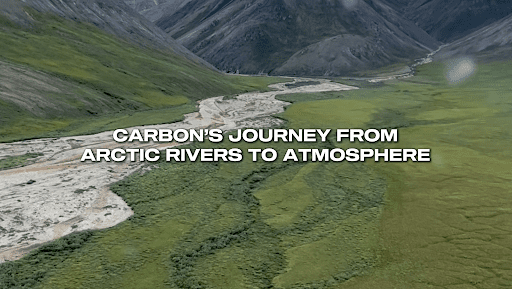
By Jack Barkhurst, Environmental Planning and Design Major, Mentor Marisa Repasch. Due to climate change, arctic regions around the world are warming nearly four times faster than the rest of the planet. Over the past few summers, Dr. Marisa Repasch, an Earth & Planetary Science Professor at the University of New Mexico, has been conducting research on the Canning River in Alaska to record an increasing amount of carbon export from the river. Carbon export is increasing because of undercutting erosion, runoff from unusual thunderstorms, and permafrost melt as a direct result of global warming. This export of particulate and dissolved organic carbon to the ocean ultimately makes its way into the atmosphere which continues the cycle of rapid warming of the Arctic. Permafrost is predicted to hold more than twice the amount of Earth’s modern atmosphere in carbon, which if released has dire consequences to the climate. For my project, I have put together an educational video using footage captured by Dr. Repasch and fellow scientists on the field alongside voiceovers of an interview with her. This video seeks to expand the public’s knowledge on how our emissions are impacting the arctic and what can be done about it. One of the solutions to global warming is that humans need to stop emitting excess greenhouse gas emissions, which come primarily from fossil fuels. Additional support to continue research in Alaska can be made through initiatives from government agencies to install satellite monitoring stations that will allow scientists and the public to better understand how rivers are eroding the landscape and how quickly permafrost is melting. As such, countries around the globe can adjust emission targets to reduce global warming accordingly.