By Diego Ruiz. Mentors Profs Jake Greenberg and Kenwyn Cradock.
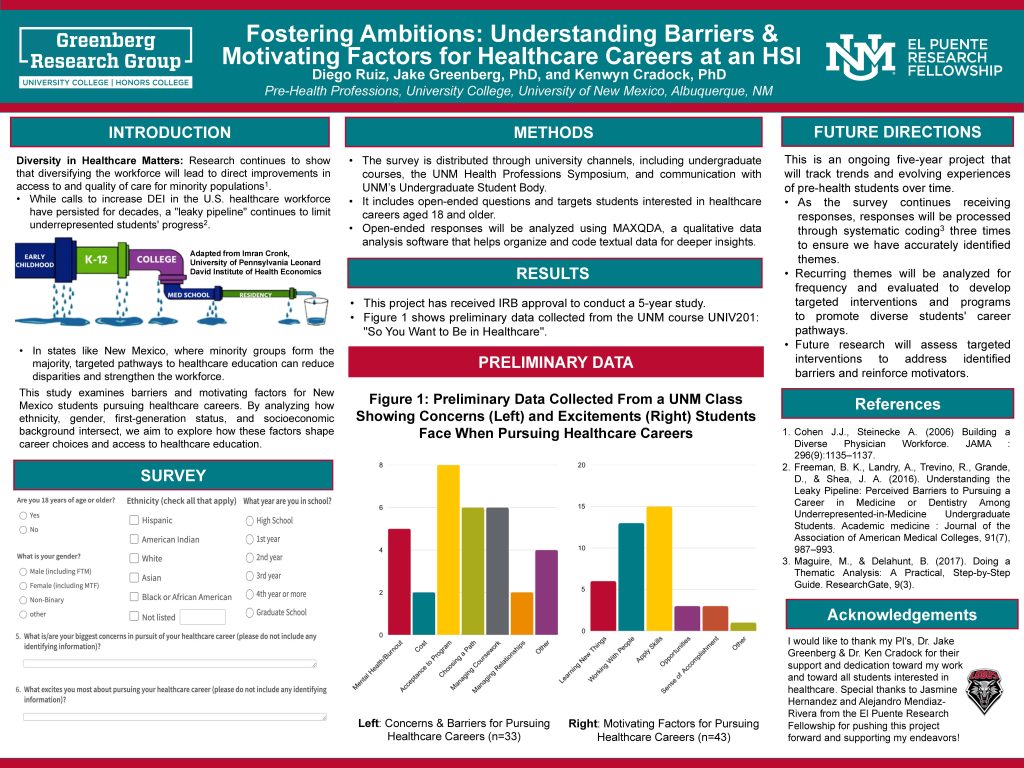
Abstract: Diversity in the healthcare workforce improves the access to and quality of care for minority populations. Despite longstanding calls for increased diversity, equity, and inclusion in healthcare, a “leaky pipeline” continues to hinder the progress of underrepresented and minority students. In New Mexico, where minority groups form the majority, interventions in healthcare education for these groups are essential for reducing disparities and strengthening the workforce. This study aims to identify perceived barriers and motivators, assess demographic correlations, and understand students’ evolving attitudes toward healthcare education. This study is conducted through a survey distributed through university channels, including undergraduate courses, the UNM Health Professions Symposium, and communication with UNM’s Undergraduate Student Body. Preliminary findings suggest that key motivators include applying knowledge and skills and collaborating with others, while concerns focus on program acceptance, managing stress, and career uncertainty. By analyzing how ethnicity, gender, first-generation status, and socioeconomic background intersect, this study seeks to reveal how these factors influence career choices and access to healthcare education, ultimately contributing to a more diverse and equitable healthcare workforce.