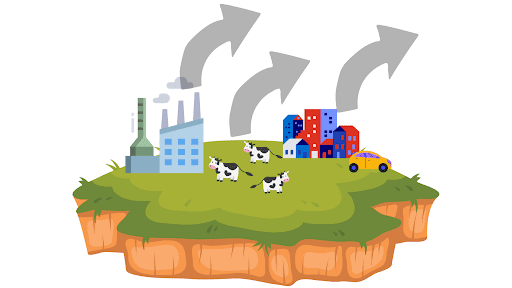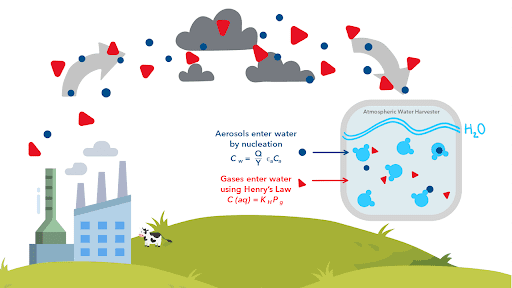
By Paris Eisenman, Civil Engineering Major, Mentors Dr. Anjali Mulchandani, Constanza Kremer and Matthew Russell. In our air, different contaminants exist known as particulate matter. These particles can be categorized as organics, inorganics, or pathogens, and can be found throughout the air in our cities and urban areas from sources such as factories, farms, and other industries. Particulate matter in the air can cause adverse health effects, depending on the contaminant. Atmospheric water harvesting is the process of taking water from the air, also known as water vapor, via machines to be used as drinking water. The risks associated with atmospheric water harvesting include the presence of these particles in water. Because there has not been much research regarding the water quality of atmospheric water harvesting, the risk must be considered regarding contaminants in untreated water collected from atmospheric water harvesting. For this communication project, I am making multiple figures for a research paper showing the process of atmospheric water harvesting and the risks associated with it. Using these four figures to relay this data would be beneficial because as this technology is further developed and eventually used as another source of drinking water, the water harvested will have different contaminants than water from surface or groundwater sources and must be treated as such. Different testing methods will have to be developed, and more policies must be put into place in order to ensure that people will have safe and clean water to drink.