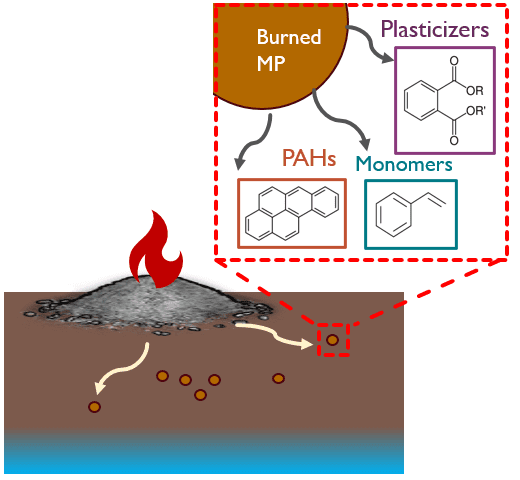
By Kenya Hernandez, Chemical Engineering Major, Mentors Maycee Hurd and Sydney Donohue Jobe. As plastic manufacturing continues to impact the world, it’s important that we become wary of how plastic waste (microplastics) is impacting the environment and even our bodies. As a rural community, the Crow Reservation of Montana has faced issues with direct access to solid waste management. As a result, they have begun to implement uncontrolled waste incineration, or more simply known as burn pits. Naturally, when communities begin to burn their waste, we find fragments of the contents left in the soil, air, and water that are within proximity. The contents of waste left in the environment will further release more harmful contaminants. With these contaminants left in the environment, we can conclude that microplastics are circling into our own body systems.
Maycee Hurd’s Research focuses on analyzing how the uncontrolled waste incineration contributes to microplastics found in the Crow community. Hurd takes samples of the most commonly used plastics and incinerates them. Once melted, she analyzes how the chemical composition of the waste changed, which allows us to predict how it may affect the environment in the future. As of recent, she has found that the microplastics left in the environment after burning will release plastic monomers, additives, and other incineration products, all of which are harmful contaminants. Microplastics in contact with direct sunlight were found to release these contaminants at a faster rate.
My communication piece is a sculpture of the human body made of Styrofoam, a commonly used plastic. The piece will show the audiences how microplastics are entering our bodies and affecting organic hormonal/circulation cycles. As plastic waste continues to enter our environment, it will continue to build up in our bodies.