
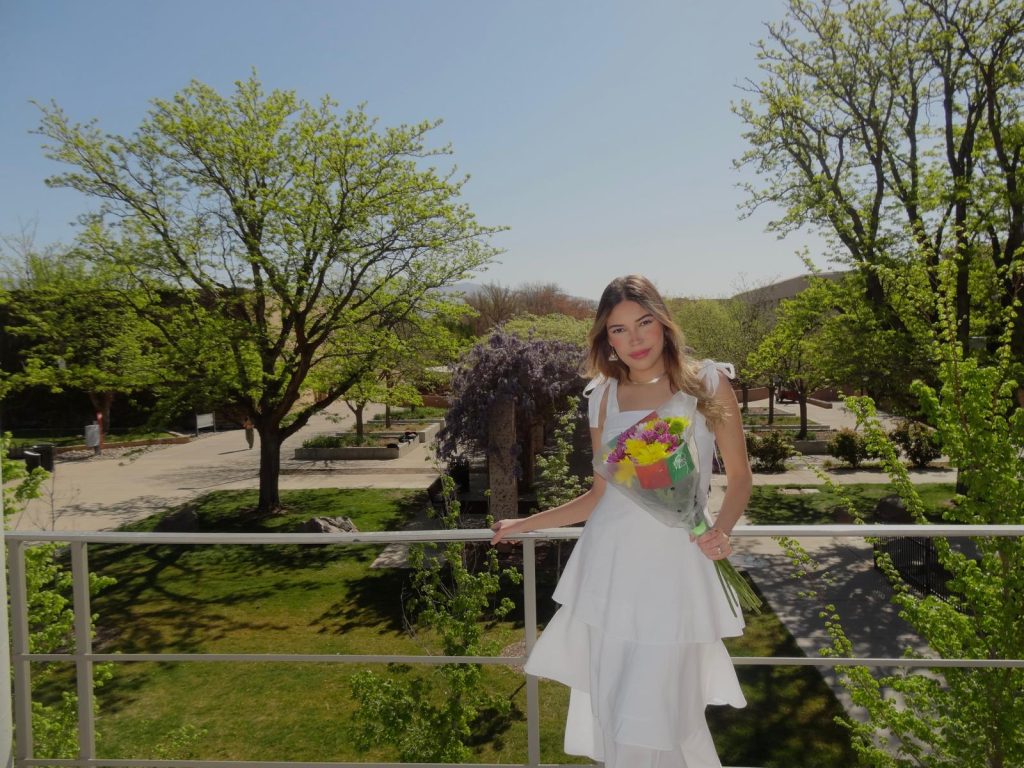
By Maria Clara Pedroza Santos, Outstanding Research Story, UROC 2025
Throughout my childhood in Brazil, I was surrounded by a myriad of scenes: camelôs (street merchants) evading inspectors, milkmen knocking door to door to sell their goods, and domestic workers rushing between homes. Work, as I understood it, came in two forms: jobs with contracts, salaries, and stability, and everything else–a makeshift economy that so many, including my own family, relied on to get by. Yet, informality was never understood as a lasting solution, only as means of survival. It wasn’t until I left Brazil in search of educational opportunities unavailable at home that I began to see the full scope of what I had lived. What I had always accepted as an unstructured and temporary way of making ends meet was in reality a large and complex system influencing the lives of millions—not just in Brazil, but across the world.
This realization sparked something in me. I began to question not just the economic structures I had taken for granted, but also the personal stories behind them, including those within my own family. My avó told me she began working at age nine, helping her parents sell produce to support a household of twelve. My paternal grandmother took part in the rural exodus—leaving the countryside for Brazil’s capital, where she worked as a domestic worker without proper labor protections or social security. These realities were flourishing a sentiment of injustice in me, one that would soon turn into purpose.
In my junior year of high school, I was accepted into a Brazilian university, but I knew that the educational dismantling that my home country was experiencing would make achieving a PhD degree nearly impossible. A teacher who believed in me encouraged me to look abroad, as Brazil was facing major research cuts, especially in social sciences. That same year, I was selected for the +Science program, where I researched using technology to detect microplastics in one of South America’s most polluted rivers. The project opened my eyes to the power of research—and the lack of support for it in Brazil. I spent the next year applying to boarding schools and earned a presidential scholarship to Menaul School in Albuquerque. Moving to the U.S. allowed me to study in a new language, reignite my passion for learning, and explore economics—my future academic path.
At the University of New Mexico, I got a job at the Bureau of Business and Economic Research (BBER), where I dove deeper into the kind of work that could uplift communities. I conducted feasibility studies for the Indian Pueblo Cultural Center, supported the Women in Business – Latina Equal Pay project for the Hispano Chamber of Commerce, and contributed to data analysis that helped shape policy conversations around equity in New Mexico. These experiences showed me the practical power of research, and they inspired me to pursue my own at a college level.That’s when I applied to the El Puente Research Fellowship, where I found more than academic support, I found community. Surrounded by students who shared similar lived experiences, I was intellectually challenged and emotionally supported. Under the guidance of Dr. Manuel Montoya, whom I had the pleasure to meet in my freshman macroeconomics class, I then discovered that economics isn’t just about markets and numbers. It’s about people. It’s about justice. It ‘s about change.
For much of my life, I had believed that informal economies were symptoms of failure proving that something in the system wasn’t working. But as I began to study labor informality, I realized that it is often a response to exclusion, not a mistake. Informality, especially in Latin America, is rooted in centuries of colonialism, economic liberalization, and social inequality. In many cases, it is not just a challenge to be fixed—but a survival strategy that deserves recognition and respect.
My research focuses on informality as a site of resistance—a space where people carve out agency in the face of exclusion. I’m exploring how the informal sector offers not just economic value but also cultural resilience. Sixty percent of the Latin American workforce is informal. That’s not just a number—it’s more than half of the region. According to the International Labour Organization, one in every two workers in Latin America and the Caribbean holds an informal job. I wanted to understand the human stories behind that statistic.
That’s what took me back to Brazil over winter break, through field research funded by the Latin American and Iberian Institute. In Rio de Janeiro, I interviewed a mate (Brazilian iced tea) vendor who began working at 16 to support his family. He spoke about decades of working without regulation, without protection—but also with pride. Despite the precariousness, he viewed his work as a craft. Today, mateiros like him are recognized by UNESCO as part of Brazil’s Cultural Heritage. Following this recognition, the mayor of Rio began offering training programs to help mate vendors improve product quality and gain access to formal markets. These programs—though not perfect—show that education and empowerment can bridge the gap between informality and formality better than harsh regulation ever could.
As I continue analyzing data from Brazil, Argentina, Bolivia, Honduras, and Mexico, one thing is clear: informal labor is not going away. It needs to be respected, protected, and integrated. Informal workers deserve community-based solutions, not marginalization. Structural change is needed and especially for groups historically excluded due to race, gender, and age.
This research has changed me. It has made me more curious, more questioning. It has made me understand that all work has a name—even if it’s not on a contract. These stories aren’t invisible. They are a testament to resilience.
My dream is to return to Brazil and work in policy research—advocating for community-based solutions that bring social security and dignity to informal workers. I’ve learned that meaningful research is not about having all the answers—it’s about asking the right questions. If I could share one piece of advice with other students starting their research journey, it would be to follow your curiosity, and don’t be afraid to make your work personal. Research is most powerful when it’s driven by purpose.